A song for my wife from Podlasie — straight from an 1892 songbook
· Mick Brzeziński
- AI
- heritage
- build in public
All audio is AI-generated; sources are strictly public domain. Voicebank: PIX DS 3 (PixPrucer) — credit required.
I wanted to give her something money can’t buy
My wife is from Podlasie — a quiet, forested borderland in Poland’s northeast that stayed rural longer than almost anywhere in the country. People there still remember walking the village in spring with a gaik: a green branch dressed in ribbons, carried house to house, with a song that the hard winter was over and the first herbs gathered. I wanted to give her a real one of those songs — not a cover, not an “inspired by,” but authentically from Podlasie: the right words, the right melody, and above all the right dialect (gwara). I thought it was an afternoon’s work. It became a detective expedition into 19th-century archives.
Hunting for a source
The obvious picks fell away fast: well-known songs get flagged by the generator as an “existing recording,” and “Jestem sobie Podlasianka” turned out to be a 20th-century authored piece, still under copyright. Rule one: nothing in copyright, and always name the collector and the edition.
The gold was in Zygmunt Gloger’s Pieśni ludu (Kraków, 1892), with music arranged by Zygmunt Noskowski. Gloger collected near his home at Tykocin — northwestern Podlasie. The pick: “Gaiczek zielony” — authentic text and Noskowski’s engraved melody from one source, and with both men gone over a century (Gloger 1910, Noskowski 1909), unambiguously free to use.
Reading the notes off a 130-year-old engraving
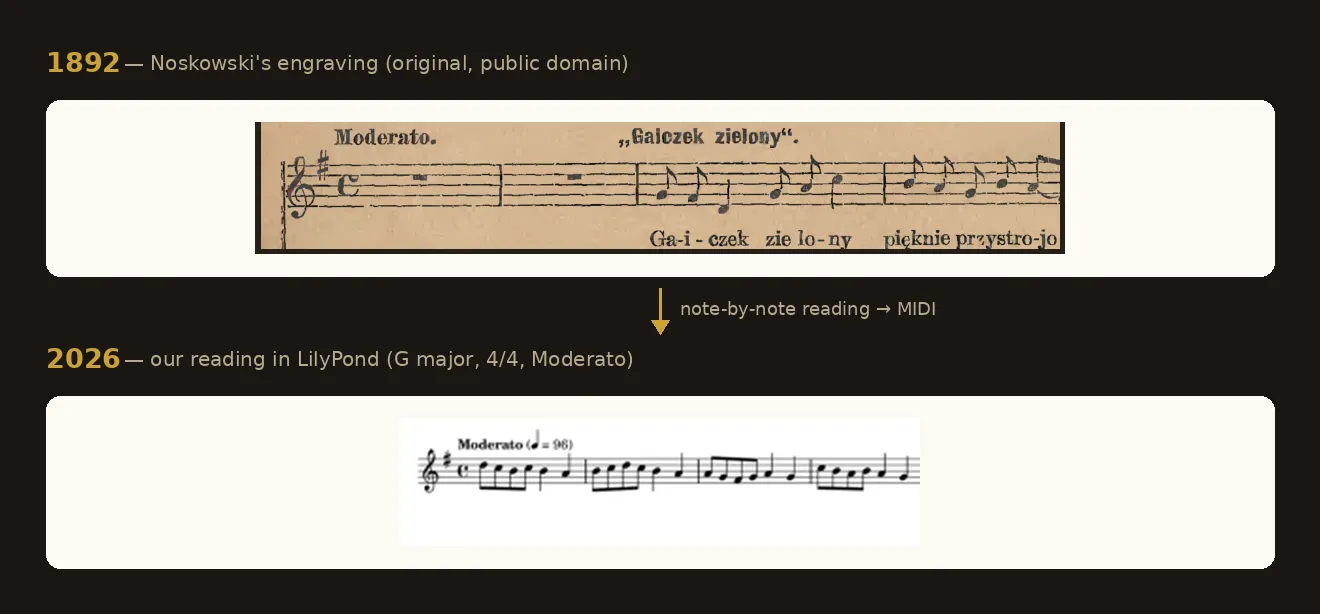
This is where the work can’t be faked. The library thumbnails were too small, so I pulled the original DjVu, rendered the page at native resolution, cropped the vocal staves, and read the melody note by note: treble clef, one sharp → G major, 4/4, “Moderato.” I wrote it out in LilyPond — labeled, honestly, as a best-effort reading of the 1892 engraving, open to correction.
The dialect — the soul of the thing
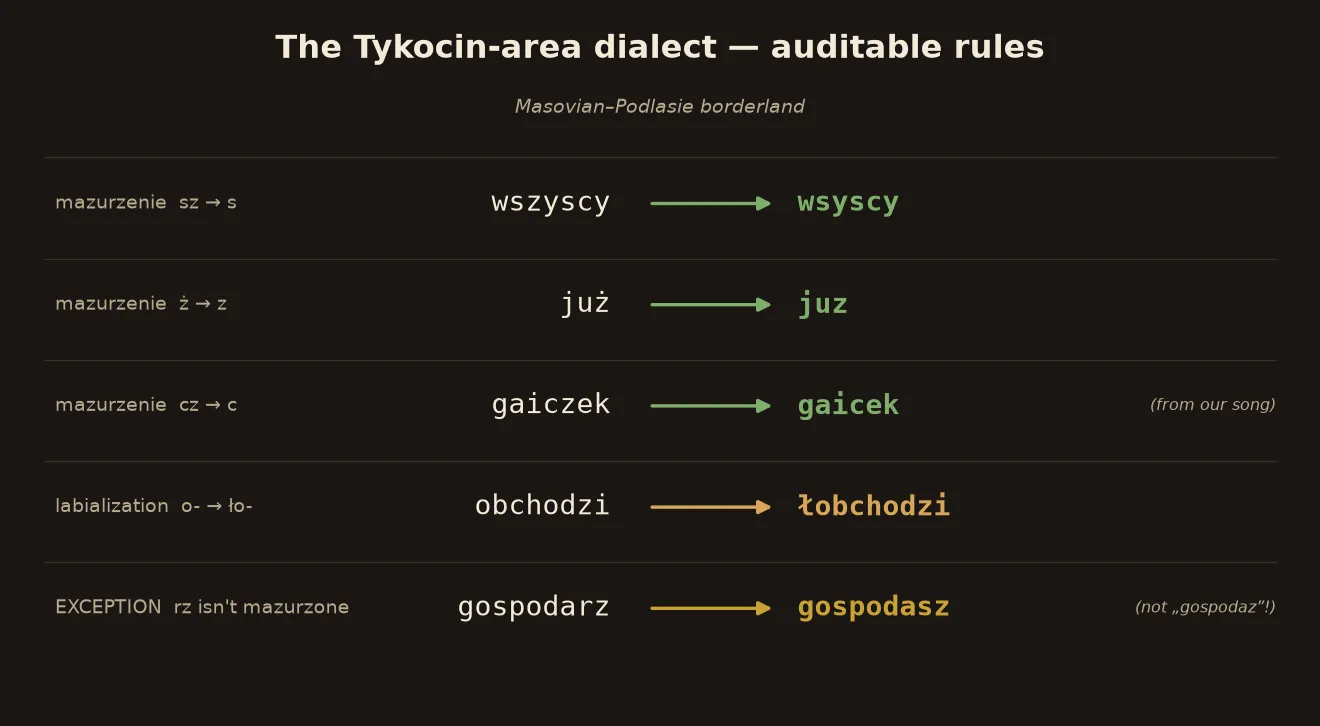
The literary text alone isn’t Podlasie. It had to be run through the Tykocin-area dialect of the Masovian–Podlasie borderland, modeled as auditable rules: mazurzenie (the Masovian merger sz, ż, cz → s, z, c — “gaiczek” → “gaicek”) and labialization (initial o-, u- pick up an “ł” — “obchodzi” → “łobchodzi”). Not cosmetic — it’s the exact sound her grandmother would have sung in.
Giving it a voice
“AI makes a song” isn’t one prompt. From the transcription we make MIDI, then a sung take with a local, headless Polish DiffSinger — PIX DS 3 — on CPU. That take has full control of the dialect: you hear the mazurzenie and labialization exactly as written — faithful in pronunciation, but synthetic and flat in how the voice carries between notes.
For a more natural sound we go to Suno: a cover over an instrumental guide, so the “audio reproduction” filter has nothing to grab and the melody stays ours. Suno re-sings it its own way — melody preserved, pronunciation not guaranteed.
”Pretty, but it doesn’t drawl”
The harshest benchmark in the world isn’t a leaderboard. It’s a woman from Podlasie listening to a machine try to sing the way her grandmother did. My render got great technical marks — from me. From my wife it got three words: “pretty, but it doesn’t drawl.”
And she was right. The drawl (zaciąganie) — the Podlasie stretching and falling of vowels — isn’t a spelling feature. It doesn’t live in the letters or the notes, only in how the voice leads sound between them. My voicebank is standard Polish: it pronounces things the Podlasie way, but it won’t drawl like a local singer. Today that’s the edge of the technology.
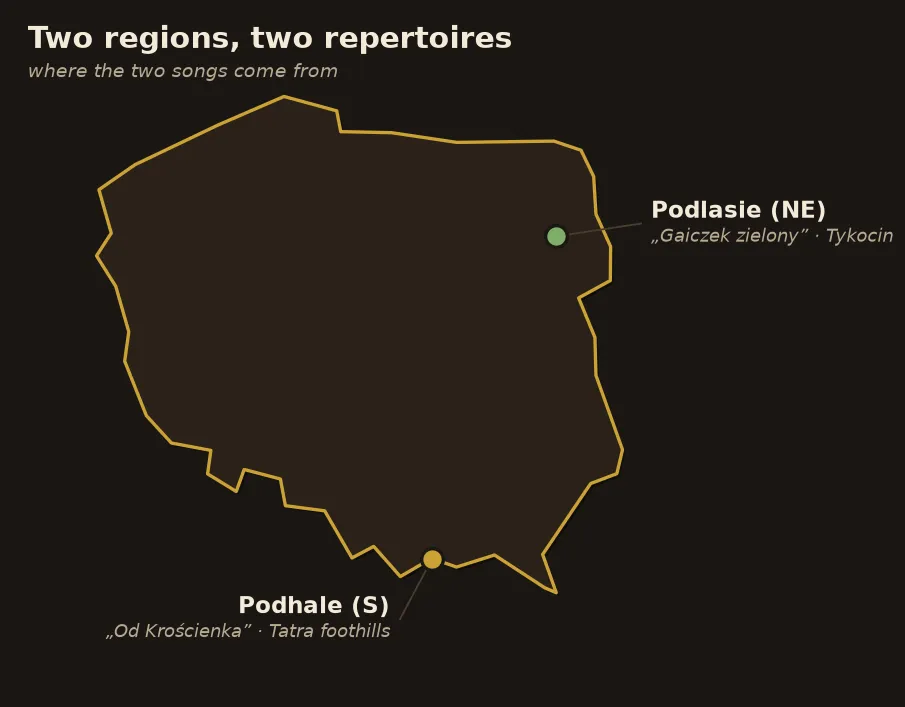
The best proof: with the same pipeline I made a song from Podhale — the Tatra highlands on Poland’s southern edge, home to the górale mountaineers and their unmistakable music — over a Kolberg-documented highlander melody (“Od Krościenka”). It came out clearly better. Because the soul of highlander music sits in the melody itself: the raised (Lydian) fourth of the góralska scale, modal cadences, an asymmetric rhythm — the whole color is written into the notes, so the model reproduces it.
When a region’s identity is in the melody, AI catches it; when it’s in the voice-leading — not yet.
The twist
Now the confession: I didn’t do any of these steps by hand.
The hours in the archives, the public-domain triage, pulling the DjVu, reading a 130-year-old engraving note by note, reconstructing the dialect, assembling it into a singing voice — all of it ran autonomously, an AI agent in a single afternoon, making its own calls along the way. The gift is still real: authentic text, a melody from a specific 1892 engraving, the right dialect, clean sources. Only the detective was a machine.
Does that make the gift less human, or just human in a different way?
Want to read how I tried to “paint in” the drawl with a prompt alone on Suno? That’s a separate post: The Suno accent trick.
Credits. Text and melody: collected by Zygmunt Gloger, music arranged by Zygmunt Noskowski, Pieśni ludu, Kraków 1892 (Gebethner i Wolff; public domain). Text transcription via Wikisource (CC BY-SA 4.0). Singing voice (native layer): the PIX DS 3 voicebank (PixPrucer, utau.pl), non-commercial license. Production layer: Suno.