The AI coding honeymoon lasts about one month
· Mick Brzeziński
- AI agents
- technical debt
- build in public
Across 807 real software projects, the first month with Cursor produced 281% more code. By the third month they were back to the velocity they had before they ever installed it — except for the extra complexity and the extra warnings, which stayed.
That’s the finding of a Carnegie Mellon study — Speed at the Cost of Quality — which matched 807 GitHub projects that adopted Cursor against 1,380 controls that didn’t, and ran static analysis over both every month. The headline version is “AI makes my team 5x faster.” The data supports something narrower and more useful: AI makes your team much faster for about a month, then hands you a bill.
Month one is real. That’s the trap.
The speed-up is measured:
- Month 1: +281% lines of code added.
- Month 2: +48%.
- Month 3: back to pre-Cursor levels.
Month one feels like you hired five engineers overnight. You ship the backlog, the demo lands, you tell everyone AI changed everything — and at that moment, you’re right. But the curve doesn’t plateau at “fast.”
What stays after the speed is gone
Two things did not return to baseline:
- Static analysis warnings: ~+30%.
- Code complexity: ~+41%.
The velocity was transient; the debt is permanent — until someone pays it down by hand. And the study shows the second causes the first: the accumulated warnings and complexity drive the long-term slowdown. The speed was never free output — it was a loan against your own future velocity, at an interest rate nobody quoted you.
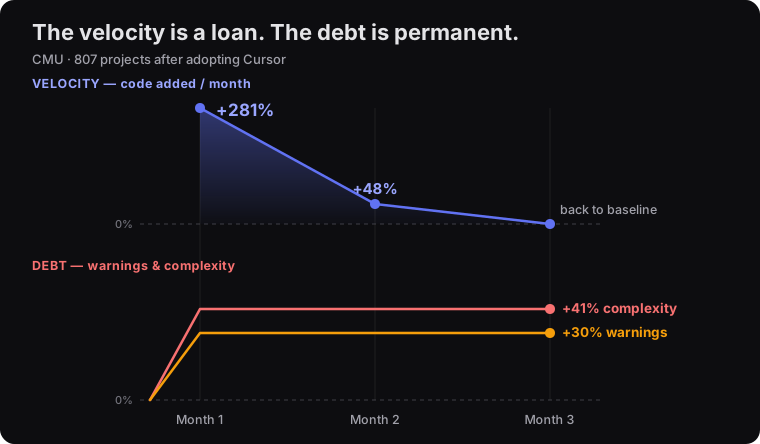
Two curves from the same study. The second one is the bill.
Why the agent can’t just clean it up later
The obvious rebuttal: fine, let the AI refactor it next month.
Except generating more code and owning a system are different skills. A May 2026 benchmark called ProgramBench — from Meta, Stanford and Harvard — handed nine frontier models (Claude Opus 4.7, GPT-5.4, Gemini 3.1 Pro among them) a compiled binary plus its documentation, and asked them to rebuild the program: real systems like SQLite, FFmpeg, the PHP interpreter. No internet, no source, no peeking at the binary.
Tasks fully solved, across all nine: zero. The strongest model cleared 95% of the tests on 3% of the tasks — real partial progress — and still finished no whole program.
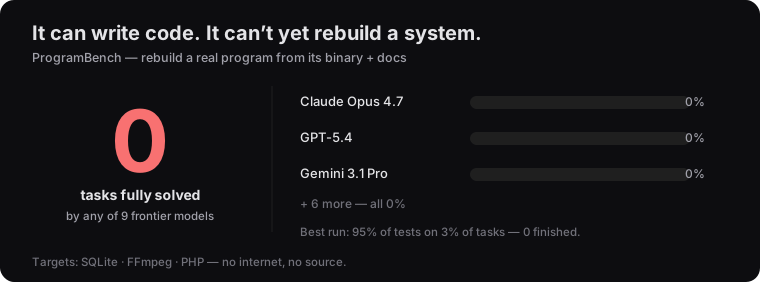
Closing a gap is not the same skill as owning a system — and the gap between them is a flat zero.
Today’s agents are excellent at closing a gap — writing a function, fixing a bug, filling in a file. They can’t yet hold a whole system’s architecture in their head and keep it coherent, which is exactly what a month-three cleanup demands. The thing that made the mess can’t reliably be the thing that owns it back out.
The fix isn’t a better model. It’s the loop around it.
ThoughtWorks’ latest Technology Radar puts a name to the shape of the answer: the coding-agent harness — the feedback loop and guardrails you wrap around the model — and a name to the failure mode it prevents, codebase cognitive debt. Same model, two outcomes: velocity that decays into debt, or velocity that compounds.
In practice that’s discipline applied during the month-one sprint, not after: a quality budget your build enforces so complexity can’t climb unseen, tests as the merge gate, small diffs a human actually reads, and a person — not the agent — owning the architecture. None of it slows you to pre-AI speed; it stops the curve from collapsing back to it.
Which to do first, ranked by impact, is its own post: the harness playbook.
So what
The weekend MVP is real, and so is the demo that wins the room. Believe both. Just don’t budget as if month one is the steady state — it’s the honeymoon, and the CMU data says it ends on schedule.
The teams that keep the speed aren’t the ones with the best model — everyone has the same models. They’re the ones who spent month one building the harness instead of only spending the speed. AI didn’t remove the need for an engineer who understands the system; it moved that need three months down the road, where it’s easy to forget you signed for it.
If you shipped fast with AI this quarter: do you know what your complexity number did while you weren’t looking?