My two-year-old has her own record label — her first hit is disco polo about carrots
· Mick Brzeziński
- AI agents
- build in public
- content as code
My daughter (2) has her own record label: ~50 compilations, an animated series, and an app on my phone — all generated from a single text file, at ~$0.10 a song. Her first hit is disco polo about carrots.
My daughter is two, and she eats her carrots to a song that sounds like it was written at a Polish village wedding at 2 a.m. — disco polo, the country’s gloriously cheesy 1990s dance-pop. It opens like a thriller:
Hey! What’s this?! What’s about to happen?! Oh! The mush is already on the table!
The tension builds — a kitten sits down at the table, heart pounding, carrot on the plate — and asks the existential question: “Is this love? Is this magic?” The answer: “No! It’s a spoon for a kiss!” Then the chorus she knows better than her own name:
Yum yum yum! Oh my! So tasty! Yum yum yum! The kitten eats like a king!
The song is called “Yum Yum – First Mush,” and it exists nowhere except my house. We wrote it with AI in one afternoon, for an audience of one: her.
Why I’m even doing this
The kids’ songs you can buy are generic or about someone else’s life. My daughter’s world right now isn’t fences and meadows — it’s mush, carrots, the spoon-for-a-kiss, and a nap after lunch.
“Kids’ content” isn’t one market. It’s millions of one-person markets, each with its own mush.
If I can write a track about a carrot, I can write the things a two-year-old can’t yet name — “I’m angry,” “I miss grandma,” “My sister gets more,” “I did it!” — songs that name the feeling before the child finds the word.
Then came the one that mattered most: a song with her name in it. The kitten stands in a meadow and calls the field to dance, then drops into a slow bridge — “little star… Kitten Klusek loves you.” The carrot song made me laugh. This one stopped being a joke and became an animated music video she knows by heart.
🎬 [MUSIC VIDEO “HEY MANIA!” — MP4, 9:16, ~90s]
How it’s made
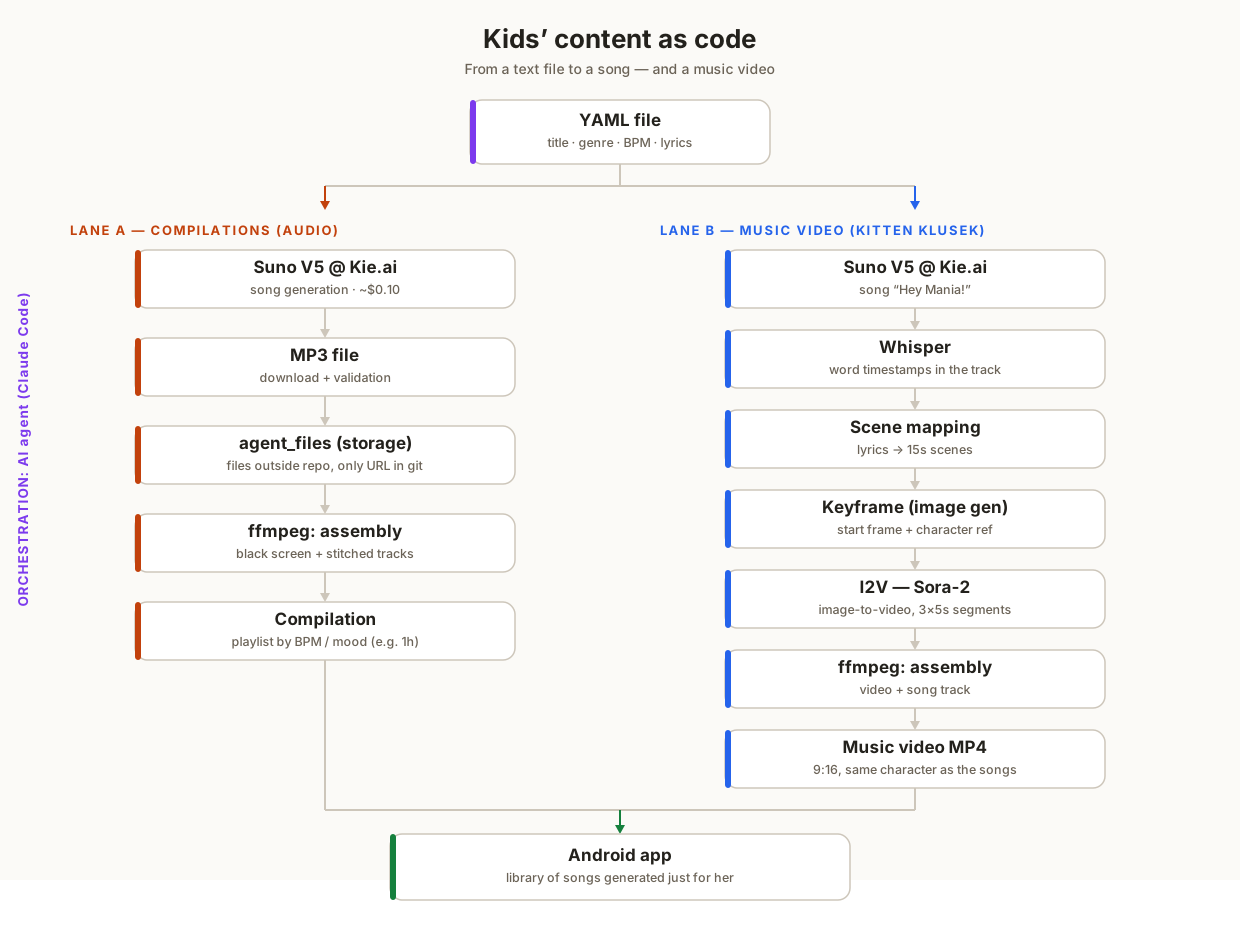
One idea runs through all of it: kids’ content as code. A song isn’t an audio file — it’s a YAML file describing what to produce. An agent (Claude Code) orchestrates the rest.
The source of a song is a dozen lines:
- id: 01
  title: "Yum Yum - First Mush"
  style: "Disco polo, Upbeat, Party, BPM 128, Children's song, Catchy"
  prompt: "Energetic Polish disco polo pastiche about a kitten trying food..."
  lyrics: |
    [Intro, Dramatic]
    Hey! What's this?! What's about to happen?!
    ...
There are two lanes, both starting from that file.
Lane A — compilations (audio). The cheap path: style + prompt + lyrics go to Suno V5 via the Kie.ai API, a client polls and pulls the MP3 (~$0.10 a song). Finished files go to separate storage — only the URL lands in git, not hundreds of megabytes of audio. Then ffmpeg stitches songs into one file (black screen + audio), sorted by BPM. That’s a “1-hour playlist.”
Lane B — music video (Kitten Klusek). When a song needs a picture, a video track kicks in: the same Suno step, then Whisper extracts word timestamps, the lyrics split into 15-second scenes, each scene gets a keyframe (character held by reference images), and that frame drives an image-to-video model (Sora-2). ffmpeg stitches the scenes and lays the song underneath (-shortest trims video to the song’s length).
Because the unit is a text file, I get everything I like about code:
- Versioning — every song and video lives in git; I can roll back.
- Repeatability — a whole playlist in a new genre is one changed
stylefield. That’s why I have disco polo and twist and ska from one pipeline. - Quality gates — before the expensive video generation, a gate checks the keyframe (does the character match?). The cheap mistake gets caught before it becomes the expensive one.
- Cheap at scale — “write my daughter 50 albums” stops being a figure of speech.
What grew out of it
It started with one disco polo about mush. Today the repo holds:
- ~50 compilations split by function of the day:
morning,wind-down,go-wild,play,lullabies - A dozen-plus genres — disco polo, rock’n’roll, twist, polka, ska, eurodance, rockabilly, surf — playlists ordered by BPM, from calm to “jumping on the couch”
- An emotions series — the songs that name feelings
- Reworked Polish folk classics and carols
- Sung fairy tales
- An animated series, “Kitten Klusek” — 100+ short image-to-video clips, same character as the songs
- An Android app — the whole library in one place to play from
So what — if you’re not writing songs for a toddler
A decade ago, a personal song about a child’s own name or her own grandma needed a label, a composer, and a budget. I did it in my pajamas, between naps, adding lines to a text file.
I don’t know if she’ll remember her dad wrote her disco polo about a carrot. I know that when she hears “Yum yum yum! The kitten eats like a king!”, she eats her broccoli without a fight. As a first review, it doesn’t get better than that.